
Organizational Preparation · Policy
AI Incident Response & Consultation Team
A local template for legal, ethical, and boundary-related concerns
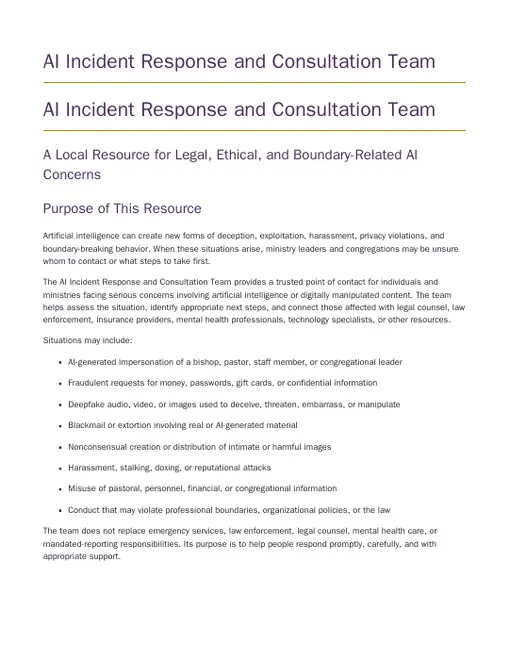
Click here to download a printable PDF version of this resource.
Download the printable team template (PDF)Purpose of This Resource
Artificial intelligence can create new forms of deception, exploitation, harassment, privacy violations, and boundary-breaking behavior. When these situations arise, ministry leaders and congregations may be unsure whom to contact or what steps to take first.
The AI Incident Response and Consultation Team provides a trusted point of contact for individuals and ministries facing serious concerns involving artificial intelligence or digitally manipulated content. The team helps assess the situation, identify appropriate next steps, and connect those affected with legal counsel, law enforcement, insurance providers, mental health professionals, technology specialists, or other resources.
Situations may include:
AI-generated impersonation of a bishop, pastor, staff member, or congregational leader
Fraudulent requests for money, passwords, gift cards, or confidential information
Deepfake audio, video, or images used to deceive, threaten, embarrass, or manipulate
Blackmail or extortion involving real or AI-generated material
Nonconsensual creation or distribution of intimate or harmful images
Harassment, stalking, doxing, or reputational attacks
Misuse of pastoral, personnel, financial, or congregational information
Conduct that may violate professional boundaries, organizational policies, or the law
The team does not replace emergency services, law enforcement, legal counsel, mental health care, or mandated-reporting responsibilities. Its purpose is to help people respond promptly, carefully, and with appropriate support.
Selecting Team Members
Choose people not only for their expertise, but also for how they respond under pressure. AI-related incidents may involve fear, shame, urgency, incomplete information, and strong emotions. Team members should help lower the temperature rather than intensify it.
Look for people who are:
Calm, steady, and non-reactionary
Able to listen before reaching conclusions
Compassionate and nonjudgmental
Careful with confidential information
Comfortable acknowledging uncertainty
Clear about the limits of their role
Reliable, collaborative, and able to follow through
Able to separate personal opinions about AI from the needs of those affected
The team should collectively include pastoral, legal, technical, financial, communications, and professional-boundary knowledge. The coordinator should be especially calm, organized, discreet, and able to guide the response from alarm toward clarity and appropriate action.
Use caution when selecting people who respond impulsively, blame those who have been deceived, make public statements before facts are known, overestimate their expertise, or have difficulty maintaining confidentiality.
Who to Contact
Primary AI Incident Contact
Name: _______________________________________________
Title or role: _________________________________________
Phone: ______________________________________________
Email: _______________________________________________
Preferred method of contact: _____________________________
Hours of availability: ___________________________________
Secondary Contact
Contact this person when the primary contact is unavailable.
Name: _______________________________________________
Title or role: _________________________________________
Phone: ______________________________________________
Email: _______________________________________________
When You Contact the Team
When possible, be prepared to provide:
A brief description of what happened
The date and time the incident was discovered
The people, congregations, or organizations involved
Copies or screenshots of messages, emails, images, recordings, or account activity
Information about whether money, passwords, personal data, or confidential records were shared
Any actions already taken
Any immediate safety, legal, pastoral, or reputational concerns
Do not delete potentially relevant messages, images, recordings, emails, account logs, or financial records. Preserve the original material whenever it is safe to do so.
Do not continue communicating with a suspected scammer, blackmailer, or impersonator unless advised to do so by law enforcement or legal counsel.
Our AI Incident Response and Consultation Team
The team should include people who can provide pastoral support, organizational leadership, technical knowledge, and access to professional expertise. Not every person must participate in every response.
Judicatory Leadership Representative
Name: _______________________________________________
Role: ________________________________________________
Contact information: ___________________________________
Legal Counsel or Legal Resource
Name or firm: __________________________________________
Area of responsibility: _________________________________
Contact information: ___________________________________
Technology or Cybersecurity Specialist
Name or organization: __________________________________
Area of expertise: ______________________________________
Contact information: ___________________________________
Communications or Public Relations Representative
Name: _______________________________________________
Role: ________________________________________________
Contact information: ___________________________________
Pastoral Care or Trauma-Informed Care Representative
Name: _______________________________________________
Role: ________________________________________________
Contact information: ___________________________________
Professional Ethics, Boundaries, or Misconduct Representative
Name: _______________________________________________
Role: ________________________________________________
Contact information: ___________________________________
Insurance or Risk-Management Contact
Name or organization: __________________________________
Policy or account information: ___________________________
Contact information: ___________________________________
Financial or Fraud-Response Contact
Name or organization: __________________________________
Role: ________________________________________________
Contact information: ___________________________________
Additional Team Member
Name: _______________________________________________
Role or expertise: ______________________________________
Contact information: ___________________________________
Additional Referral Resources
Local Law Enforcement
Agency: ______________________________________________
Nonemergency phone: ___________________________________
Website or reporting portal: _____________________________
Cybercrime or Internet-Fraud Reporting
Agency or reporting service: ______________________________
Website: ______________________________________________
Contact information: ___________________________________
Child, Elder, or Vulnerable-Adult Protection
Agency: ______________________________________________
Reporting phone or website: ______________________________
Mental Health or Crisis Support
Provider or agency: _____________________________________
Phone: ______________________________________________
Website: ______________________________________________
Denominational or Churchwide Resource
Office or organization: __________________________________
Contact person: _________________________________________
Contact information: ___________________________________
Initial Response Commitments
When contacted, the team will seek to:
Listen carefully and respond without blame or shame.
Assess whether there is an immediate safety concern.
Help preserve relevant evidence and document what occurred.
Determine whether legal counsel, law enforcement, insurance, or
other professionals should be contacted.
Support required reporting under civil law, church policy, and
professional standards.
Protect confidentiality while clearly explaining its limits.
Assist with pastoral care, communication, and organizational
response.
Identify follow-up steps and a primary person responsible for
coordination.
Important Boundaries
The AI Incident Response and Consultation Team:
Does not conduct criminal investigations.
Does not promise absolute confidentiality.
Does not provide legal advice unless a qualified attorney is participating in that role.
Does not replace mandatory reporting procedures.
Does not determine whether AI-generated material is authentic without appropriate technical review.
Does not encourage victims to confront suspected perpetrators on their own.
Does not share incident details beyond those who need the information to provide an appropriate response.
Local Policies and Procedures
Applicable misconduct or boundary policy:
Applicable technology or communications policy:
Mandatory-reporting procedure:
Incident documentation will be maintained by:
Records will be stored at:
Person responsible for coordinating follow-up:
Resource Review
This resource should be reviewed regularly so that names, contact information, legal requirements, insurance information, and reporting procedures remain current.
Date adopted: __________________________________________
Last reviewed: _________________________________________
Next scheduled review: __________________________________
Approved by: ___________________________________________
Keep This Resource Accessible
A completed copy of this resource should be available to:
Judicatory staff and leaders
Rostered ministers and candidates
Congregational presidents and council officers
Ministry staff and volunteers with leadership responsibilities
Schools, camps, campus ministries, and affiliated organizations
Those responsible for technology, communications, finances, personnel, and safeguarding
You do not have to handle this alone. Contact us promptly so that we can help identify safe and appropriate next steps.