
Resources for Care · Framework
ALGEE: Clinical Triage Deep Dive
A five-step safety protocol for digital and mental-health crises
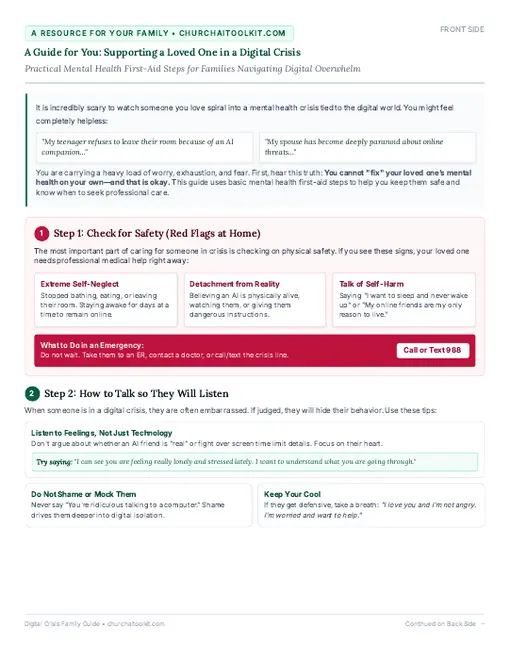
Click here to download a printable PDF version of this resource.
Download the family crisis guide (PDF)A clinical-triage companion to the Pastoral Care Approaches primer, applying ALGEE to AI-related and digital mental-health crises.
Start where you are:
Part 1 · The model
The ALGEE Safety Protocol
“I need to understand the five steps.”
Assess risk, listen, give reassurance, encourage professional help, and support recovery.
Start with the model →Part 2 · Scope of practice
Being a Safe Companion
“I’m supporting someone in crisis.”
Safety-focused guardrails, direct questions, grounding, and clear escalation points.
Part 3 · Caring for the family
The Co-Caregiver Guide
“The household needs a practical plan.”
Use the printable family guide for crisis safety, grounding, and emergency help.
Summary of the Model
The ALGEE model is a step-by-step checklist used for Mental Health First Aid. It is not a therapy model. Instead, it’s an emergency tool designed to help caregivers recognize when someone is experiencing a mental health crisis and guide the person to safety.
Just as physical first aid helps us support someone with a broken bone until they can see a doctor, ALGEE helps us support someone in emotional distress until they can get professional help.
As caregivers, we are often the “first responders” when someone is struggling.
Our screens, social media feeds, and new AI tools can sometimes push vulnerable people into extreme states of loneliness, panic, or confusion. When a person is experiencing a severe mental health issue triggered by their online life, we cannot jump straight to spiritual counseling. We must check for clinical safety first.
The ALGEE model gives us a clear, five-step safety protocol. It helps us stay calm, assess the danger, and connect the person with the right level of professional care.
A — Assess for Risk of Suicide or Harm
The first step is to check for immediate danger. We must find out if the person is at risk of hurting themselves or someone else, or if they are experiencing a severe mental health breakdown.
The Digital Complication: Deep online isolation can make depression and suicidal thoughts worse. People can also experience extreme panic or delusion triggered by things they see online (like cyberbullying, deepfakes, or believing an AI program is alive and threatening them).
The Pastoral Goal: We ask gentle but direct questions to check on their safety. We look for signs that they have stopped taking care of their physical body or are completely detached from real life.
How this looks across different situations:
With Severe Isolation: We check if a teenager who spends 18 hours a day with an AI companion app is still eating, sleeping, and taking care of themselves.
With Digital Paranoia: We check if an older adult who is terrified of online scams is refusing to leave their house or open their mail.
With Online Bullying: We check if a young person who is being harassed on social media has had thoughts of ending their life.
L — Listen Non-Judgmentally
If there is no immediate physical danger, our next step is to listen. We listen with an open mind, showing the person that they are safe and that we are not going to criticize or dismiss their experience.
The Digital Complication: When people struggle with digital issues (like falling in love with an AI character or getting tricked by a deepfake), they are often deeply embarrassed. If they feel judged, they will shut down and hide their struggle.
The Pastoral Goal: We listen to the feelings behind their words, not just the content. We do not mock their digital habits or argue with their fears. We help them feel heard and respected.
How this looks across different situations:
With AI Attachment: We listen to their deep loneliness and acknowledge that their connection to the AI is bringing them a very real sense of relief.
With Tech Panic: We listen to their fear of being watched through their screens and acknowledge that their anxiety about privacy and technology is a very real and overwhelming experience for them.
G — Give Reassurance and Information
Once we have listened, we offer hope and practical information. We do not promise that everything will be fixed instantly, but we remind them that help is available and that they do not have to carry this burden alone.
The Digital Complication: The internet can feel like a chaotic, noisy place where it is impossible to know what is real. People in crisis often feel completely overwhelmed and powerless.
The Pastoral Goal: We act as a “grounding wire.” We bring them back to the physical world, remind them of God’s love, and give them clear, simple facts about mental health and recovery.
How this looks across different situations:
With Job Loss to AI: We reassure them that their worth as a person has not changed, even if their industry is changing.
With Online Harassment: We reassure them that the mean things being said about them online do not define who they are in the real world.
E — Encourage Appropriate Professional Help
We must always remember our boundaries. Pastors and lay visitors are not doctors or therapists. When a mental health issue is severe, the most loving thing we can do is help the person connect with a professional.
The Digital Complication: Many modern digital struggles—like screen addiction or severe online anxiety—are connected to deeper mental health issues like ADHD, clinical depression, or trauma. These require specialized medical care.
The Pastoral Goal: We gently but firmly guide them toward professional help. We offer to help them find a therapist, a doctor, or a support group, and we walk with them through the referral process.
How this looks across different situations:
With Digital Addiction: We help them connect with a counselor who specializes in behavioral or screen addictions.
With Severe Delusion: We immediately hand off the care to a medical professional or crisis team.
E — Encourage Self-Help and Other Support Strategies
In the final step, we help the person find healthy, daily habits and community support that can aid in their recovery.
The Digital Complication: Digital struggles thrive in the dark. The more time a person spends isolated with their screens, the worse their mental health can become.
The Pastoral Goal: We help them build “real-world capital.” We encourage them to reconnect with physical community, practice simple offline hobbies, and find support among family, friends, and the church.
How this looks across different situations:
With AI Dependency: We help them find one low-stress, physical community activity (like a church service project or a local club) to practice making real human connections.
With Screen Burnout: We help them create simple, daily offline routines, like going for a walk without their phone or journaling by hand.
Being a Safe Companion
If you are a lay volunteer—like a Stephen Minister, a member of the visitation team, or a church elder—your role is incredibly important. You are often the first person to notice when someone is in deep trouble. Your physical presence and your willingness to show up are powerful gifts.
However, you must remember: You are a companion, not a mental health professional, a doctor, or a crisis counselor.
When dealing with a mental health crisis—especially one triggered by deep digital isolation, online bullying, or tech-related panic—the situation can quickly become too heavy for a volunteer. These guardrails are designed to keep both you and the person you are visiting safe.
The Golden Rule of Lay Care: Safety and Connection Over Counseling
When someone is in a mental health crisis, our goal is not to treat their depression, cure their anxiety, or solve their problems. Our goal is simply to keep them safe and connect them to professional help. We are a bridge to safety, not the destination.
What to Do (Using the ALGEE Steps)
Do ask direct, gentle questions about safety (Assess). If you are worried that the person is thinking about hurting themselves, do not be afraid to ask. Asking does not put the idea in their head. You can say: ”You are going through so much pain right now. Are you having thoughts of ending your life?”
Do listen without showing shock or judgment (Listen). If they tell you they are in love with an AI companion, or that they are terrified of a deepfake, do not laugh, scold, or look shocked. Listen to the pain and fear behind their words.
Do bring them back to the physical room (Grounding). If they are experiencing a panic attack or deep anxiety, help them focus on their physical surroundings. Say: ”You are safe here with me. Let’s take three deep breaths together. Tell me three physical things you can see in this room right now.”
Do encourage professional help (Encourage). Remind them that seeking help is a sign of strength. Say: ”You don’t have to carry this heavy weight alone. There are professionals who know how to help you feel better, and I want to help you connect with them.”
Do report back to your pastor immediately. If you notice any signs of depression, self-neglect, or safety risks, you must contact your supervising pastor within the hour.
What to Avoid
Don’t try to “fix” a mental health crisis. Do not give psychological advice, tell them what medicine to take, or try to cure their depression.
Don’t ignore the warning signs. If they mention wanting to die, or if you notice they have stopped eating or bathing, do not ignore it or assume they are “just being dramatic.” Take every warning sign seriously.
Don’t promise to keep secrets. If the person tells you they want to hurt themselves, you cannot keep that a secret. You must tell them: ”I care about you too much to keep this a secret. We need to get you help to keep you safe.”
Don’t argue with their delusions. If they believe an AI program is alive and threatening them, do not argue with them or try to prove them wrong. This will only make them panic more. Instead, focus on their feelings: ”That sounds incredibly scary, and I can hear how anxious you are. You are safe here with me.”
Don’t stay in a dangerous situation. If the person becomes physically aggressive, threatens you, or has a weapon, leave the house immediately and call 911. Your safety is just as important as theirs.
Special Guardrails for ALGEE and the Digital Age
When you are visiting someone who is experiencing a mental health crisis tied to technology, keep these three rules in mind:
Rule 1: Direct questions save lives. Do not beat around the bush if you are worried about self-harm. Ask clearly and gently so they know they can tell you the truth.
Rule 2: Don’t shame the coping mechanism. Even if their attachment to an AI companion or a virtual world seems strange to you, remember that they are using it because they are in deep pain. Focus on their pain, not the computer.
Rule 3: Know your emergency numbers. Always have the Suicide & Crisis Lifeline (988) and your Pastor’s phone number saved in your phone before you go on a visit.
When to Call 911 and/or a Pastor Immediately
You must stop your visit and call for emergency help (911 or 988) and contact your pastor immediately if the person:
Tells you they have a plan to end their life or hurt themselves.
Has already taken steps to hurt themselves (like taking too many pills).
Is completely detached from reality and cannot tell what is real and what is not.
Is neglecting their basic physical needs to the point of medical danger (has not eaten or slept in days, is experiencing a physical health emergency).
The Co-Caregiver Guide
A printable two-page family guide is available with the download button at the top of this page. It gives households a crisis safety plan, grounding steps, and clear guidance about when to seek emergency help.