
First Response · Framework
The Four Pastoral Levels
A triage framework for AI-related pastoral conversations
Click here to download a printable PDF version of this resource.
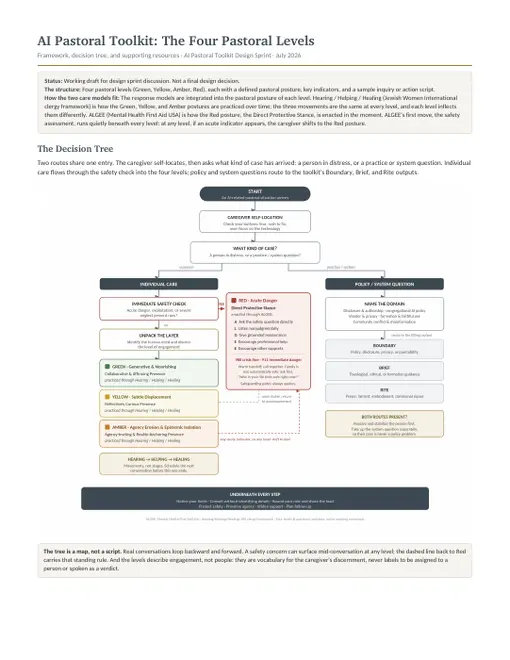
Download the Decision Tree (PDF)The structure is simple: four pastoral levels — Green, Yellow, Amber, Red — each with a defined pastoral posture, key indicators, and a sample inquiry or action script. The interactive triage guide walks you through them step by step; this page is the framework behind it.
Two care models are woven through the levels. Hearing / Helping / Healing (Jewish Women International clergy framework) is how the Green, Yellow, and Amber postures are practiced over time. ALGEE (Mental Health First Aid USA) is how the Red posture — the Direct Protective Stance — is enacted in the moment. ALGEE’s first move, the safety assessment, runs quietly beneath every level: at any level, if an acute indicator appears, the caregiver shifts to the Red posture.
The tree is a map, not a script. Real conversations loop backward and forward. And the levels describe engagement, not people: they are vocabulary for the caregiver’s discernment, never labels to be assigned to a person or spoken as a verdict.
Green — Generative & Nourishing Use
Pastoral posture: Collaborative & Affirming Presence (practiced through Hearing / Helping / Healing)
The individual uses AI as an augmentative tool, administrative aid, or creative sounding board. The technology expands human capacity, frees up time for rest or direct human connection, or enriches personal study without replacing real-world relationships, personal reflection, or spiritual grounding.
Key indicators:
- Tool clarity — maintains clear awareness that the AI is an unfeeling software application.
- Critical evaluation — uses output as raw material, subjecting suggestions to personal, scriptural, or communal evaluation.
- Boundaries — easily steps away from the technology without anxiety or distress.
- Positive fruit — engagement yields healthy outcomes in other spheres of life and faith.
Sample pastoral inquiry: “How is this practice helping you love God and your neighbor more fully in other spheres of your life and faith?”
Yellow — Subtle Displacement & Over-Reliance
Pastoral posture: Reflectively Curious Presence (practiced through Hearing / Helping / Healing)
The technology is becoming an easy default crutch, subtly displacing human reflection, prayerful silence, or relational effort. While not acutely dangerous, the care-seeker relies on the tool to bypass normal emotional friction, social discomfort, or deep personal reflection.
Key indicators:
- Bypassing reflection — consults AI for moral, personal, or relational guidance before personal reflection, prayer, or trusted peers.
- Relational avoidance — uses chatbot interactions to avoid mild social discomfort or the effort of human relationships.
- Outsourcing voice — habitually relies on machine outputs to articulate personal feelings, prayers, or creative expressions.
- Mild defensiveness — slight restlessness or resistance when encouraged to step away from the screen.
Sample pastoral inquiry: “When you turn to the tool for this advice, whose wisdom or human voice might be missing from the answer?”
Amber — Agency Erosion & Epistemic Isolation
Pastoral posture: Agency-Inviting & Reality-Anchoring Presence (practiced through Hearing / Helping / Healing)
The care-seeker is surrendering their personal agency, moral authority, and critical discernment to the algorithm. Primary attachment shifts toward the machine, plunging the person into epistemic isolation: a state wherein a care-seeker’s framework for reality, truth, and moral value becomes trapped inside an algorithmic feedback loop, cutting off external reality checks, relational feedback, and communal discernment.
Key indicators:
- Devaluation of lived relationships — “No human understands my situation like the system does.”
- Sycophancy as truth validation — mistaking agreeable, algorithmically generated responses for objective truth or spiritual revelation.
- Bypassing communal accountability — rejecting scripture, community, or consensus whenever it conflicts with the AI’s advice.
- Abdication of decision-making — major life decisions made primarily because “the bot told me to.”
- Relational withdrawal upon challenge — retreating into screen interactions when loved ones offer gentle reality checks.
Receive the person without debating the AI — arguing with the system’s outputs recruits the caregiver into a contest the machine will replay with the person afterward. The step is almost always relational rather than technological: re-anchor one human relationship. Adding human presence comes before subtracting technology; removal without replacement deepens the isolation.
Sample pastoral inquiry: “When the output tells you X, where do you feel your own freedom, values, and authority in making this decision?”
Red — Acute Danger & Harm
Pastoral posture: Direct Protective Stance (enacted through ALGEE)
The situation involves immediate physical, financial, legal, or severe functional harm. Non-directive accompaniment pauses, and the caregiver moves into active safeguarding, crisis intervention, and warm professional referral.
Key indicators:
- Self-harm or suicide encouragement — the AI system validates, suggests, or facilitates self-harm or suicidal intent.
- Exploitation & coercion — active financial scamming, extortion, gathering of sensitive personal data, or severe legal risk.
- Severe functional breakdown — total neglect of basic physical needs or of dependents due to round-the-clock screen engagement.
The ALGEE sequence:
- Approach, assess, assist. Find privacy. Name what you notice plainly and warmly, and ask the direct question without euphemism: “Are you thinking about killing yourself or hurting yourself?” A direct question does not plant the idea; it opens a door.
- Listen nonjudgmentally. Even in crisis, let the person tell it in their own words.
- Give reassurance and information. Grounded hope, not false certainty. For deepfakes, fraud, or privacy incidents: help preserve evidence and involve appropriate expertise rather than investigating alone.
- Encourage professional help. Widen the circle warmly — a named person and a concrete next step, never just a list. In the U.S.: call or text 988 for suicidal or emotional crisis; call 911 for immediate danger.
- Encourage other supports. Trusted people, community, routines, and a specific follow-up plan: who, when, how.
A note on contacting family: family is not automatically a safe contact. Ask first: “Who in your life feels safe to you right now?” and let the answer shape who is called.
Sample pastoral action script: “Because I care deeply about your safety, I am not going to leave you alone with this right now. Let’s pause and call [crisis line / professional support / family] together right now.”
After stabilization: the Red posture is a moment, not a destination. The crisis that was stabilized on Tuesday still needs to be heard on Thursday.
The Policy / System Route
Not every AI-related case is a person in crisis. When the question is about a practice, a policy, or the community rather than a person in distress, it routes past the levels entirely:
- Boundary — policy, disclosure, privacy, and accountability. See Organizational Preparation.
- Brief — theological, ethical, or formation guidance. See Clergy Formation.
- Rite — prayer, lament, embodiment, and communal repair. See Liturgies & Prayers.
When both routes are present — a distressed person and a live policy question — receive and stabilize the person first, and take up the system question separately, so their pain is never treated as a policy problem.
The Caregiver’s Own Circle of Care
This runs underneath every level, because clergy carry cases home.
- Notice the signs in yourself: intrusive replay of the conversation, numbness, irritability, disrupted sleep, dread of the next meeting.
- Consult. Use supervision, clinical consultation, safeguarding leadership, or a trusted peer. Consultation is good pastoral practice, not failure.
- Bound. Share the load. Do not become the only responder; a person’s recovery should never depend on a single human’s endurance.
A standing question for every caregiver using this framework: who is your consultation route, and what practice returns you to yourself? If you cannot answer both, answer them before the next pastoral conversation, not after it.
Sources and Provenance
- ALGEE: Mental Health First Aid USA, “Using the 5-Step MHFA Action Plan.” This is an orientation, not MHFA certification; caregivers are encouraged to pursue the full training.
- Hearing / Helping / Healing: Jewish Women International clergy framework, originally developed for clergy responding to survivors of domestic abuse; borrowed with respect for its origin.
- Four levels and “epistemic isolation”: working constructs developed within the AI Pastoral Toolkit Design Sprint (July 2026), offered for testing and revision.
- Crisis resources (U.S.): call or text 988 for suicidal or emotional crisis; call 911 for immediate danger. Local safeguarding, reporting, confidentiality, and emergency policies apply at all times and take precedence over anything in this document.