
Resources for Care · Framework
Hearing, Helping, Healing: Deep Dive
The three-step pastoral sequence, worked out in practice
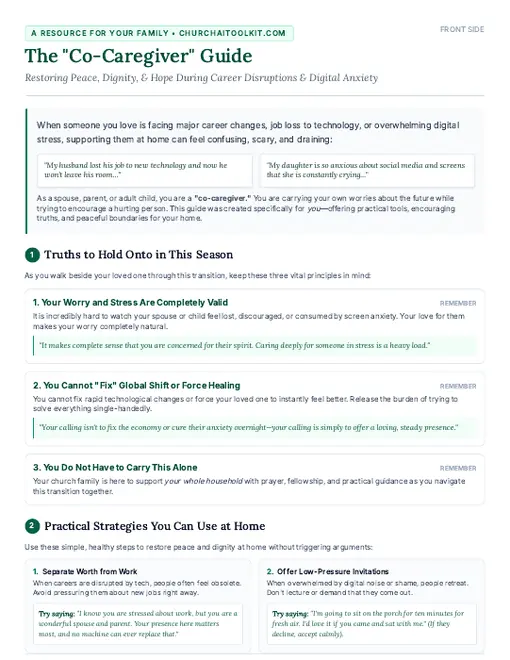
Click here to download a printable PDF version of this resource.
Download the family handout (PDF)A companion to the Four Tasks of Grief: Deeper Dive, applying the Hearing, Helping, Healing sequence to job loss, screen anxiety, and digital fear.
Start where you are:
Part 1 · The model
Hearing, Helping, Healing
“I want to understand the pastoral sequence.”
Move from deep listening, to shared discernment, to one faithful next step.
Start with the model →Part 2 · Scope of practice
Being a Safe Companion
“I’m preparing to accompany someone.”
What to do, what to avoid, digital-age guardrails, and when to call the pastor.
Part 3 · Caring for the family
The Co-Caregiver Guide
“A worried family member needs support.”
Use the printable handout for career disruption and digital anxiety.
Summary of the Model
The Hearing, Helping, Healing model is a simple, three-step guide for holding a pastoral conversation. When someone comes to us with a problem, our natural instinct is often to try and “fix” it right away. We want to give advice, offer solutions, or make the discomfort go away. But when people are dealing with deep, complicated questions about their life, quick fixes do not work.
This model ensures we care for the person’s soul first, before we try to help them with their practical problems. It is a sequence that moves from deep listening, to shared thinking, and finally to faithful action.
While this model can be used for any pastoral situation, it is especially helpful when people are facing the confusing and fast-moving world of new technology. It helps caregivers guide parishioners through the anxiety, shame, or ethical dilemmas that come in the digital age.
Step 1: Hearing — Active Listening and Sitting with the Pain
In this first step, the caregiver’s only job is to listen. We do not offer advice, we do not share our own opinions, and we do not try to make the person “look on the bright side.” We create a safe space for them to share their raw emotions.
The Pastoral Goal: We listen for the “soul wound” beneath the surface. We let them speak their fear, anger, or shame without interrupting them. We validate their feelings, letting them know that they are safe and that we are not going to judge them.
How this looks across different situations:
With Job Loss: We sit with their shame and anger about feeling replaced or useless.
With Screen Anxiety: We listen to a parent’s exhaustion and fear that they are losing touch with their child.
With Digital Fear: We listen to an older adult’s deep anxiety about deepfakes and not knowing what is real anymore.
Step 2: Helping — Discerning Boundaries and Finding the Truth
Once the person has felt completely heard, we transition to the step of discernment. Together, we look at the situation and help them separate the lies they might be believing from the truth of who they are in God’s eyes.
The Pastoral Goal: We act as a partner in thinking. We help them draw healthy boundaries. We look at what they can control and what they cannot. We remind them of their sacred worth, which is given to them by God and can never be taken away by a machine, an algorithm, or a difficult circumstance.
How this looks across different situations:
With Job Loss: We help them separate their human worth from their economic productivity. We remind them that a machine can do tasks, but it cannot have a soul.
With Screen Anxiety: We help the family identify where technology is crossing the line and hurting their real-world connections.
With Digital Fear: We help them find grounding in physical, real-world relationships and routines that are safe and trustworthy.
Step 3: Healing — Restoring Dignity and Taking Action
In the final step, we help the person take one small, meaningful step forward. This is not about solving the entire problem in one day. It is about restoring their dignity and their sense of agency (their power to make choices in their own life).
The Pastoral Goal: We co-create a small action plan. We offer spiritual practices, prayers, or small opportunities to participate in community life. We do not do the work for them; we walk beside them as they take back control of their daily life.
How this looks across different situations:
With Job Loss: We bless them as they begin the work of rebuilding, and we invite them to share their unique, non-automated gifts with the church.
With Screen Anxiety: We help them set one simple, achievable boundary at home, like a screen-free dinner table.
With Digital Fear: We offer a prayer of peace and help them commit to a daily, offline routine that keeps them connected to the physical world.
Being a Safe Companion
If you are a lay volunteer—like a Stephen Minister, a member of the visitation team, or a church elder—your role is incredibly important. You are the hands and feet of Jesus. When someone is anxious, overwhelmed, or questioning their worth, your physical presence shows them that God is with them.
However, you must remember: You are a companion, not a therapist, a financial planner, or a career counselor.
Life transitions and digital changes can be deeply confusing. When people face these challenges, it is easy to feel like you have to “fix” their life, find them a job, or solve their technology problems. These guardrails are designed to keep both you and the person you are visiting safe.
The Golden Rule of Lay Care: Presence Over Fixing
Your goal is not to solve the person’s practical problems or cure their anxiety. Your goal is simply to be with them in their struggle. You cannot fix their circumstances, but you can help them carry the weight.
What to Do (Using the HHH Steps)
Do focus on listening (Hearing). Let the person talk about their fears, their stress, or their feelings of being left behind by the world. Let them express their anger or worry. Your primary job in the first step is to listen, not to speak.
Do point them to their sacred worth (Helping). Gently remind them that God loves them for who they are, not for what they do or how much they produce. Help them see that their value comes from being made in the image of God, and no machine or change in circumstances can ever take that away.
Do bring the focus back to what they can control (Helping). If they are overwhelmed by big, scary changes in the world or their workplace, gently guide them back to the present moment. You can say: ”There are a lot of big things we cannot control right now. But what is one small, healthy thing we can do today?”
Do offer physical and spiritual comfort (Healing). Bring a bulletin from church, a card, or a small treat. Offer to pray with them before you leave. Read comforting words from the Bible, like Psalm 139, which reminds us how deeply God knows and values us.
Do report back to your pastor. Let your Pastor know how the visit went. If you notice they are starting to withdraw from life, stop eating, or seem deeply depressed, tell the pastor immediately.
What to Avoid
Don’t try to be a professional advisor. Do not give career advice, resume tips, or financial counseling. Do not try to diagnose a mental illness. Do not say things like, ”I think you have clinical anxiety.” Refer those questions to professionals.
Don’t get bogged down in technology debates. Do not argue about whether AI is good or bad, or get lost in complicated technical discussions. Keep the focus entirely on the person’s heart and soul, not the computer or the software.
Don’t rush to “Healing.” It is tempting to jump straight to giving advice or saying, ”Everything will work out!” before the person is done sharing. Make sure you spend plenty of time in the Hearing step before you try to move to Helping or Healing.
Don’t make the visit about you. Do not spend the visit talking about your own career struggles, your own opinions on technology, or your own anxieties. Keep the focus on them.
Don’t keep secrets that put them in danger. If they tell you they want to hurt themselves, or that they have stopped eating, you must tell the pastor. Never promise to keep a safety risk a secret.
Special Guardrails for HHH and the Digital Age
When you are visiting someone who is feeling overwhelmed, anxious, or left behind by technology, keep these three rules in mind:
Rule 1: Focus on the person, not the machine. The technology itself is not the focus of your visit. The focus is the human soul. Whether they are stressed about AI at work, overwhelmed by social media, or scared of deepfakes, care for their heart, not their computer.
Rule 2: Separate human worth from economic worth. In our world, people are often told they are only valuable if they are busy and productive. Gently push back against this lie. Remind them that a machine can do tasks, but only a human being can love and be loved.
Rule 3: Keep your visits offline. When you are with them, make the visit a “screen-free zone.” Keep your own phone in your pocket or car, and gently ask them if you can put phones away so you can focus entirely on each other.
When to Call the Pastor Immediately
You should contact your supervising pastor within the hour if the person you visited:
Mentions suicide, wanting to die, or feeling like their family would be better off without them.
Is experiencing extreme, unrealistic paranoia (like believing they are being watched or controlled through their screens).
Has stopped taking care of their basic physical needs (no food in the house, has not bathed in weeks, is neglecting their medical health).
Appears to be under the influence of alcohol or drugs during your visit.
The Co-Caregiver Guide
A printable family handout for career disruption and digital anxiety is available with the download button at the top of this page. It gives families three truths to hold onto, five practical home strategies, and common traps to avoid.
For grief-focused accompaniment, see Four Tasks of Grief: Deeper Dive.